Floyd Tibbits's death
'Salem's Lot: A NovelFloyd Tibbits's death is a decisive investigative turning point in Jerusalem’s Lot. He dies in the drunk tank after being taken into custody, and the death first appears to be a medical failure: Susan Norton reports that Dr. James Cody attributes it to acute anemia, despite Floyd’s known high blood pressure and the fact that the Army had rejected him for that condition. Yet Floyd’s unnaturally peaceful body, the alarmed reaction of Parkins Gillespie, and the later discovery that his corpse has vanished from the Cumberland County Morgue transform the episode from an isolated death into evidence of the vampire outbreak.
Circumstances and Discovery
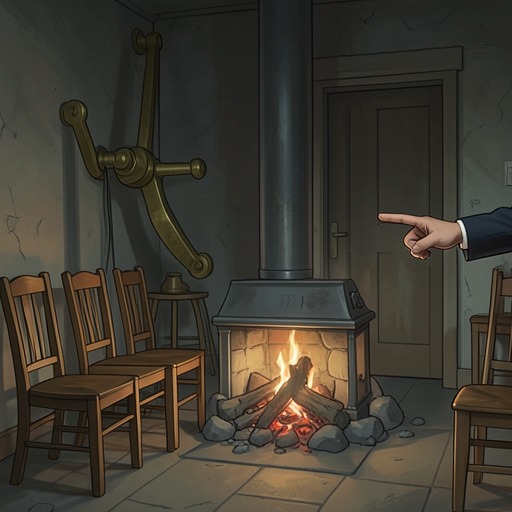
Nolly Gardener discovers the crisis gradually rather than through a dramatic announcement. When he brings Floyd breakfast from the Excellent Café, Floyd is asleep; Nolly leaves him undisturbed, even eating the hard-fried eggs, bacon, and coffee himself. At lunchtime Floyd remains in exactly the same position. Nolly becomes frightened, sets the tray down, and strikes the bars with a spoon before deciding to open the cell.
Parkins Gillespie responds to Nolly’s alarm with irritation, asking whether banging on the bars will make Floyd better. He unlocks the cell and shakes Floyd’s shoulder, but Floyd falls from the chained bunk onto the floor. Nolly immediately recognizes that he is dead. Parkins’s response is more revealing: he stares at Floyd’s uncannily reposeful face, appears terrified, and says that he wishes he had not touched the body before telling Nolly to get the doctor.
The scene’s quietness is important. There is no struggle, visible violence, or public disturbance inside the cell. Floyd’s death is presented through immobility, delayed recognition, and the uneasy mismatch between the body’s peaceful appearance and Parkins’s instinctive horror. The ordinary custodial routine—food delivery, a locked door, a turnkey’s inspection—becomes the first administrative frame around an event that ordinary procedure cannot explain.
Medical Explanation and Growing Suspicion
The death is quickly absorbed into medical language. Susan Norton telephones Ben Mears from the hospital and tells him that Floyd died in his cell sometime during the night. She reports Dr. Cody’s diagnosis of acute anemia, then immediately challenges it with Floyd’s medical history: he had high blood pressure, which was why the Army had refused to accept him. Her distress links the death to the earlier medical mystery surrounding Danny Glick, whose admission record recorded shock, partial memory loss, nausea, loss of appetite, constipation, and general loginess after being admitted on September 22, 1975.
The comparison becomes explicit when Matt Burke examines another suspicious corpse. At Matt Burke’s house, James Cody, M.D., inspects the body while Matt says that its condition reminds him of what Cody had said about the Glick boy. Cody’s reaction establishes a pattern rather than a single anomaly. Later, at Green’s Mortuary, Jimmy Cody observes that Marjorie Glick’s body resembles Mike Ryerson’s: there is no surface lividity and no sign of rigor or incipient rigor. Floyd’s alleged acute anemia therefore participates in a wider chain of bodies whose appearances resist familiar medical expectations.
This is where the novel’s medical vocabulary becomes double-edged. Terms such as anemia, encephalitis, hospitalization, examination, and morgue registration offer institutions a way to classify abnormal bodies, but they also delay recognition of the supernatural cause. The diagnoses do not simply explain the deaths; they temporarily conceal their relation to the returning dead. At the same time, the accumulating irregularities allow medical observation to become an instrument of discovery: the failure of expected postmortem signs helps Ben Mears, Matt Burke, and James Cody perceive that the cases belong together.
From Cell Death to Missing Corpse
Floyd’s death acquires its full significance after his body enters the institutional system and then disappears from it. A morgue record identifies Floyd Martin Tibbits as male and records his admission on October 4, 1975, with James Cody as signatory. The body is supposed to be a fixed administrative fact: named, catalogued, and placed behind a numbered locker.
That certainty collapses when workers find the locker empty. Buddy Bascomb and Bob Greenberg discover that the door stands open, yet no body is inside. Buddy insists that he had been at the desk and that nobody passed him; the disappearance is pushed toward the uncertainty of another shift, but no ordinary explanation is supplied. The missing corpse converts Floyd’s death from a suspicious medical case into a physical impossibility witnessed within a controlled institution.
The next disclosure widens the threat. Someone has stolen bodies from the Cumberland County Morgue in Portland, an act described as resembling a horror film drawn from Boris Karloff and Mary Shelley. The theft makes Floyd’s disappearance part of a larger movement of corpses beyond Jerusalem’s Lot. Death is no longer an endpoint managed by families, doctors, police, or morticians; the dead are being removed from the places designed to contain them.
Consequences for the Investigation
Floyd’s death gives Susan Norton a reason to contact Ben Mears and forces the investigators to treat the town’s recent deaths as connected. Ben is already being pushed toward belief after Jimmy Cody’s earlier thumbnail account of Danny Glick’s case, even though he and Cody had laughed at the vampire possibility. Floyd’s death makes that laughter untenable: the medical explanation is strained, the body behaves strangely, and the corpse later vanishes.
The episode also draws the police, medical examiner, mortuary, and hospital into the same expanding network of evidence. At Green’s Mortuary, the county sheriff questions Ben and Jimmy while deputies dust for fingerprints and take photographs; Brenton Norbert arrives with a camera to document the body. Such procedures promise order, but the investigation proceeds through gaps in that order—unusual corpses, uncertain diagnoses, missing remains, and officials who can record an event without understanding it.
Floyd’s death therefore functions as a threshold. Before it, the unexplained deaths might still be separated into accidents, illness, alcoholism, or personal misfortune. After it, the pattern includes a dead man whose body cannot be kept in custody. The event does not yet reveal every fact about the vampire colony, but it establishes that the town’s crisis is active, contagious, and capable of penetrating the institutions meant to certify death itself.